
This was the first thing we wrote down after opening, because it was the question we were asked most often in the first fortnight. People arrive wanting to know how much they should be lifting. It is almost never the useful question in month one.
The only goal that matters this month
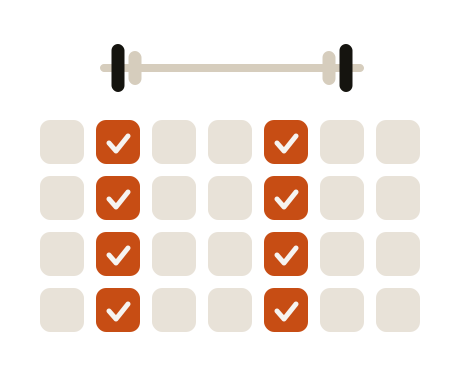
Turn up on the days you said you would turn up. That is the whole goal. Not a number on the bar, not a change in the mirror, not a personal best. Attendance, on the specific days you picked, for four weeks.
This sounds like the sort of thing a coach says to avoid answering the question. It is not. Almost everyone who is still training here after five years got through their first month by treating it as an attendance problem, and almost everyone who disappeared in week three had made it a performance problem instead.
Pick your days before you need them
Decide now which two days of the week you train, and pick them for the reason that they are hard to cancel rather than the reason that they sound ideal. A Tuesday at 6.45am that nothing else competes with beats a Thursday evening that gets eaten by work every other week.
Two days a week is enough to get properly stronger for a good year or more. It is not a starter option that you graduate from. Plenty of members who have been here since 2017 still train twice a week, and they are strong.
Learn the warm up until it is boring
We use the same warm up in every session for a reason. In month one it is something you have to concentrate on. By month two you will be doing it while talking to somebody about their weekend, and that frees up all of your attention for the lifting, which is where you want it.
If you learn nothing else in four weeks, learn the warm up.
Use less weight than you can
You will be able to lift more than we put on the bar in your first month. That is deliberate. We are buying you a few weeks of clean repetitions while the movement is still being written into your body, because whatever you practise now is what you will do automatically at heavier weights later.
Lifting slightly too light for a month costs you nothing. Lifting slightly too heavy for a month costs you the next six months, because the pattern you grooved has to be unpicked before anything can be built on it.
The bar is a teaching tool before it is a load. In your first month it is mostly a teaching tool.
Write it down, every time
Every session ends with five minutes of writing. What you lifted, how it felt, anything the coach said that landed. It feels unnecessary in week one and it is the single most useful habit you will build.
The reason is simple. In week nine you will want to know whether a weight that feels hard today felt hard in week three, and memory is a poor witness. The log answers it in four seconds.
What will actually happen to your body
Weeks one and two: you will be sore in places you did not know were places. This settles. It is not a sign of a good session and its absence is not a sign of a bad one.
Weeks three and four: the weights start moving quickly, sometimes surprisingly so. Most of this early jump is your nervous system getting better at the job rather than new muscle, which is genuine progress and worth enjoying, but it does mean the rate will not hold forever. When it slows down in month three, nothing has gone wrong. See how much weight to add each week for what the slower version looks like.
You will probably sleep better. Most people do, and it is usually the first change anyone mentions to us.
What to leave alone for now
- Your diet. Changing how you eat and how you train in the same month means that when something works you will not know which one did it. Give training four weeks on its own. When you are ready, protein without the noise covers the only part that reliably matters.
- Extra sessions. Enthusiasm in month one is not a reliable guide to what you can sustain in month five. Add a third day when two have felt easy for a while.
- Anything you read about advanced programming. None of it applies to you yet, and most of it will not apply for years.
- Comparisons. The person next to you is on a different programme, in a different decade of their life, with a different history. The only useful comparison is with your own log.
What to ask us
Ask why. Why this lift, why this weight, why this order. Every answer exists and a coach who cannot give you one has not thought hard enough about your programme. Members who ask why end up understanding their own training within a year, which is the actual aim of coaching. We would rather work ourselves out of a job than keep you dependent on us.
At the end of the month
Look at the log rather than the mirror. Count the sessions you attended out of the sessions you planned. If that number is seven or eight out of eight, the month worked, whatever the weights say.
Then book the next four weeks, and do it again.