
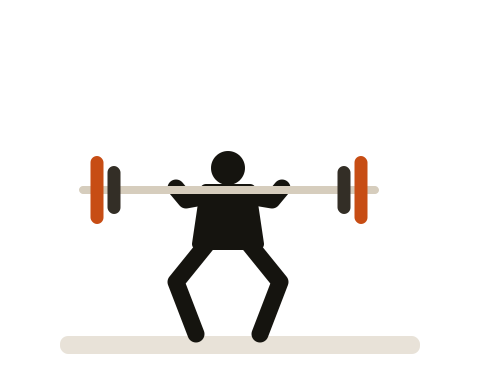
Almost everyone arrives with an opinion about squatting, usually one they picked up second hand, usually involving the word knees. Here is what we teach, in the order we teach it, and why.
What the squat is actually asking of you
To sit down between your feet while keeping your spine roughly where it started, and then to stand back up. That is all. Every cue we use is in service of one of those two things.
It is worth saying plainly that squatting is not inherently dangerous, and it is not bad for your knees. Knees are designed to bend under load. What causes trouble is not the movement but the mismatch between the load and what you have prepared for.
Where the bar sits
On the muscle across the top of your back, not on your neck. Pull your shoulder blades together and a shelf appears. That shelf is where the bar goes. If the bar is resting on bone, move it down.
Grip the bar with your hands wide enough that your shoulders are comfortable and narrow enough that the shelf stays tight. Wrists straight, elbows pointing down and slightly back rather than flaring behind you. Your hands are holding the bar in place, not holding it up.
Setting your stance
Feet roughly shoulder width, toes turned out somewhere between fifteen and thirty degrees. There is no single correct stance because there is no single hip. Some people squat beautifully with their feet close together and some need them much wider, and both are right if they let you sit down comfortably.
Find yours by squatting without a bar a few times, moving your feet each time until one position feels like it takes the least effort. That is the one.
Going down before going up
Take a big breath and hold it, brace as though you are about to be poked in the stomach, then break at the hips and knees at the same time and sit down between your feet. Keep your weight through the middle of the foot. Come back up by driving the floor away, keeping your chest facing the same direction it faced at the bottom.
Breathe out at the top, not on the way up. That held breath is doing real work supporting your spine.
The three things that usually go wrong
Your knees fall inwards
Nearly always weakness rather than technique, particularly in the muscles at the side of the hip. The cue that works for most people is to push the outside edges of your feet into the floor as you stand. If it keeps happening under load, we take weight off and add hip work rather than repeating the cue louder.
Your hips shoot up first
You stand up with your hips and your chest follows late, which turns a squat into an awkward hinge. This is usually a bracing problem. Take twenty kilos off, breathe properly, and make the chest and hips rise together for a few weeks.
You come up on your toes
Sometimes ankle stiffness, sometimes shoes with a soft heel, sometimes both. Flat shoes fix it about half the time on their own. If not, we work on the ankle and shorten the range for a while.
Depth, and the arguments about it
The standard we use is the crease of the hip finishing below the top of the knee. Deeper than that is fine if your body allows it comfortably. Shallower is fine too, for a while, if that is where you can hold position.
What we do not do is chase depth by letting the lower back round at the bottom. Depth you cannot control is not depth, it is a collapse. Better to squat to a consistent height you own and earn the rest over months. Nobody has ever regretted taking the slow route here.
If it hurts
Discomfort in the muscles is expected. Sharp pain in a joint or in your back is not, and it means stop the set and tell the coach. That is not being dramatic and it will not annoy anybody. If your back is the reason you are cautious, training with a bad back covers how we handle it.
How to practise this week
- Squat without a bar, ten easy repetitions, before your session. Not a workout, just rehearsal.
- Film one set from the side, at about knee height. What you feel and what happens are frequently different things, and the camera settles it in seconds.
- Keep the weight at something you could do three more repetitions with. Every one of them should look the same.
The squat takes most people a year to feel genuinely comfortable and about three to feel good. That is normal, it is not a reflection on you, and there is no shortcut worth taking. When you are adding weight to it, the guide on adding weight explains the sensible increments.