
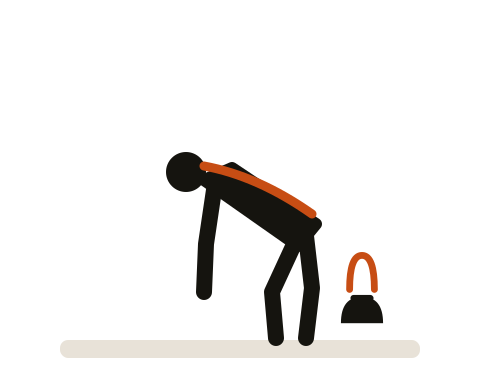
More people come to us because of a back than for any other single reason. Some have had one bad episode years ago and have been careful ever since. Some are in the middle of it now. This is what we do, written down so you can decide before you get here.
The necessary bit first
We are coaches. We do not diagnose anything, we do not treat anything, and we will not tell you what is wrong with your back. If you have not had it looked at by a doctor or a physiotherapist, please do that, particularly if you have pain going down a leg, any numbness, any weakness in a foot, or anything that woke you at night without moving.
Once you have advice from a clinician, we will work to it, and we would genuinely rather speak to them than guess. That offer is open and a fair number of members have taken it.
What a bad back usually is not
For most people it is not a structure that has broken and cannot be loaded again. Backs are robust. Scans of people with no pain at all routinely show bulges, wear and degeneration, which tells you those findings are a normal part of having lived rather than an explanation on their own.
What this means in practice is that a sore back is usually a sensitive back rather than a damaged one, and sensitivity responds well to gradual, predictable loading. It responds badly to avoidance, because avoidance shrinks the range of things your back believes it can do.
Why lying still stopped being the advice
Bed rest was standard advice for a long time and the evidence turned against it. People who keep moving within comfortable limits generally recover faster and have fewer repeat episodes than people who stop.
That does not mean pushing through pain. It means finding what you can do comfortably today, doing that, and letting the amount grow. Which is, conveniently, a description of strength training.
What we actually change
Less than people expect. The lifts stay the same lifts. What changes is the range, the load and the order.
- Range first. If a full squat is uncomfortable, we squat to a box at a height that is not. Then we lower the box over weeks.
- Deadlifts from a height. Pulling from blocks or from the pins in the rack shortens the range without removing the lift. Most people are back to the floor within a couple of months.
- Load stays light for longer. Deliberately. The aim in the early weeks is a string of sessions where nothing flares, because that string is what rebuilds confidence.
- More carries and more single leg work. Both load the trunk without asking your spine to move much, and both are quietly excellent.
This is the shape of the return to training programme, and it is why the first four sessions are one to one rather than in a group.
Hinging without fear
Bending forward is the movement people avoid most and need most. A back that never learns to bend under load stays fragile, because the first time you pick up something awkward in the real world it will be doing something unrehearsed.
We teach it with light weight, a short range, and a lot of repetitions, until it is boring. Then we make the range longer. Then we make it heavier. It usually takes a few months and it is worth every one of them.
The aim is not a back that avoids bending. It is a back that bends often enough to be good at it.
The flare up plan
Assume you will have a flare at some point, because most people do, and having a plan removes most of the panic.
- Keep moving, gently. Walking is the reliable option.
- Come in and train the parts that are fine, which is usually most of them. A session of upper body work and carries beats a week on the sofa.
- Drop back to a range and a weight that feel safe, then rebuild over a fortnight in small steps.
- Tell the coach. We write it in the log, because the pattern of flares over a year is genuinely useful information.
What progress looks like
Not a straight line. A typical good year involves two or three mild flares, each shorter and less alarming than the last, and a steady increase in the amount of life that no longer requires thinking about.
Members tend to report the change outside the gym first. Picking a child up without bracing for it. Getting through a long drive. Putting a bag in the overhead locker without the small negotiation that used to precede it. The numbers on the bar go up too, but that is rarely the part anyone mentions.
If you are over fifty and this is your situation, training in your fifties covers the rest of what changes and, more usefully, what does not.