
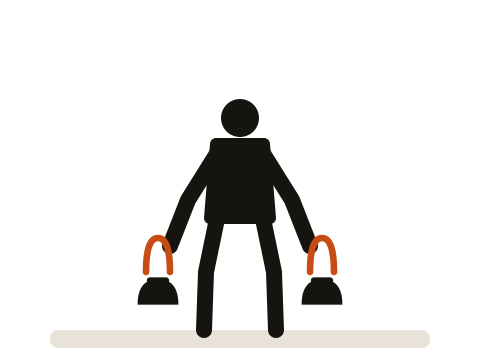
A good number of our members started lifting after fifty, several after sixty, and one after seventy. The most common thing they say afterwards is that they wish they had not waited, and the second most common is that they expected to be told to be careful and were not.
What actually changes
Three things, and it is worth being straight about them.
- Recovery takes longer. Not dramatically, but noticeably. A session that took two days to shake off at thirty might take three at fifty five. This affects how often you train rather than how hard.
- Muscle is lost faster when you do nothing. From around fifty, adults lose muscle mass steadily unless something is asking them to keep it. This is the single most important fact in this guide.
- Warming up earns its keep. In your twenties you could skip it and pay nothing. That deal expires.
What does not change
Your ability to get stronger. This surprises people and it should be said loudly: muscle responds to training at seventy in much the same way it does at thirty. More slowly, from a lower starting point, but the mechanism is intact and it does not switch off.
The lifts do not change either. We are not going to hand you a pair of light dumbbells and a resistance band. You will squat, hinge, press, pull and carry, on the same equipment as everybody else, which is what the over fifties strength sessions are.
The programme for a fit fifty five year old and a fit thirty five year old differs mostly in how often they train, not in what they do.
Why it matters more now, not less
Strength in later life is not about appearance and it is barely about the gym. It is about the number of things you can still do on your own.
Getting off the floor unaided. Carrying shopping in one trip. Catching yourself when you trip rather than going down. Managing stairs with a suitcase. Every one of those is a strength task, and every one of them quietly disappears from people's lives in their sixties and seventies, usually without anybody noticing until it has gone.
Falls are the part worth naming plainly. The strength of your legs and hips, and your ability to react quickly, are among the things you can most directly influence, and lifting weights influences both. This is the least glamorous argument for strength training and by some distance the best one.
Bone, balance and grip
Loading a bone through muscle pulling on it is one of the few things that maintains bone density, which is why we keep squats and deadlifts in the programme rather than replacing them with machines. Standing on one leg under a bit of load is where a lot of the balance comes from, so single leg work stays in too. And grip is worth training on its own, both because it tends to fade and because it turns out to track fairly well with general robustness in later life.
That is most of what the carries at the end of an over fifties session are doing, and it is why we have not quietly dropped them for something easier.
Warming up properly
Our over fifties sessions warm up for longer than the others, about twelve minutes rather than eight, and it is not padding. Joints move more comfortably once they have been asked to a few times, and the first working set feels considerably better for it.
The warm up is also where we find out what sort of day it is. If something is stiff or sore this morning, it shows up there, and the session gets adjusted before anything heavy happens.
Recovery between sessions
Two sessions a week, with two or three days between them, suits most people in this decade better than three sessions crammed together. Some members build to three and thrive on it. Others train twice a week for years and get steadily stronger the whole time.
Sleep does more here than it did twenty years ago, and it is worth reading sleep and recovery alongside this. So does eating enough protein, which becomes slightly harder and slightly more important at the same time. Protein without the noise covers the numbers.
If you have something going on
Most people arriving in this decade have something. A replaced hip, a knee that complains, blood pressure medication, a shoulder that has never been right since 1998. None of it rules you out and all of it is worth telling us about, because it changes the programme in small sensible ways rather than large dramatic ones.
If it is your back, training with a bad back covers our approach in detail. If you are coming back from surgery or a long absence, start with return to training.
A realistic first year
Months one and two: learning the lifts, light weight, more soreness than you would like in the first fortnight and much less thereafter.
Months three to six: steady increases, most weeks. This is the part people enjoy most. Stairs and shopping get easier before the numbers get impressive.
Months seven to twelve: slower, more uneven, punctuated by a week off for a holiday or a cold. By the end of it you will be meaningfully stronger than you were, sleeping better, and much harder to knock over.
That is a good year, and it is available in your fifties, your sixties and your seventies. The only version that does not work is the one you keep meaning to start.